Why Cloud-Native Architecture Is the Future for Indian Enterprises
India's digital economy is growing at a pace that legacy architectures simply cannot sustain. UPI processed over 14 billion transactions in a single month in 2024. The Digital India programme is connecting hundreds of millions of citizens to government services online. Enterprises across banking, insurance, retail, and manufacturing are scaling digital operations faster than ever before.
The question is no longer whether to modernise — it's whether your architecture can keep up.
Cloud-native architecture is the answer. And for Indian enterprises specifically, the case has never been stronger.
What Cloud-Native Actually Means
"Cloud-native" is one of the most overused and misunderstood terms in technology. It doesn't simply mean "runs on the cloud." An application running on an EC2 instance is cloud-hosted. That's not the same thing.
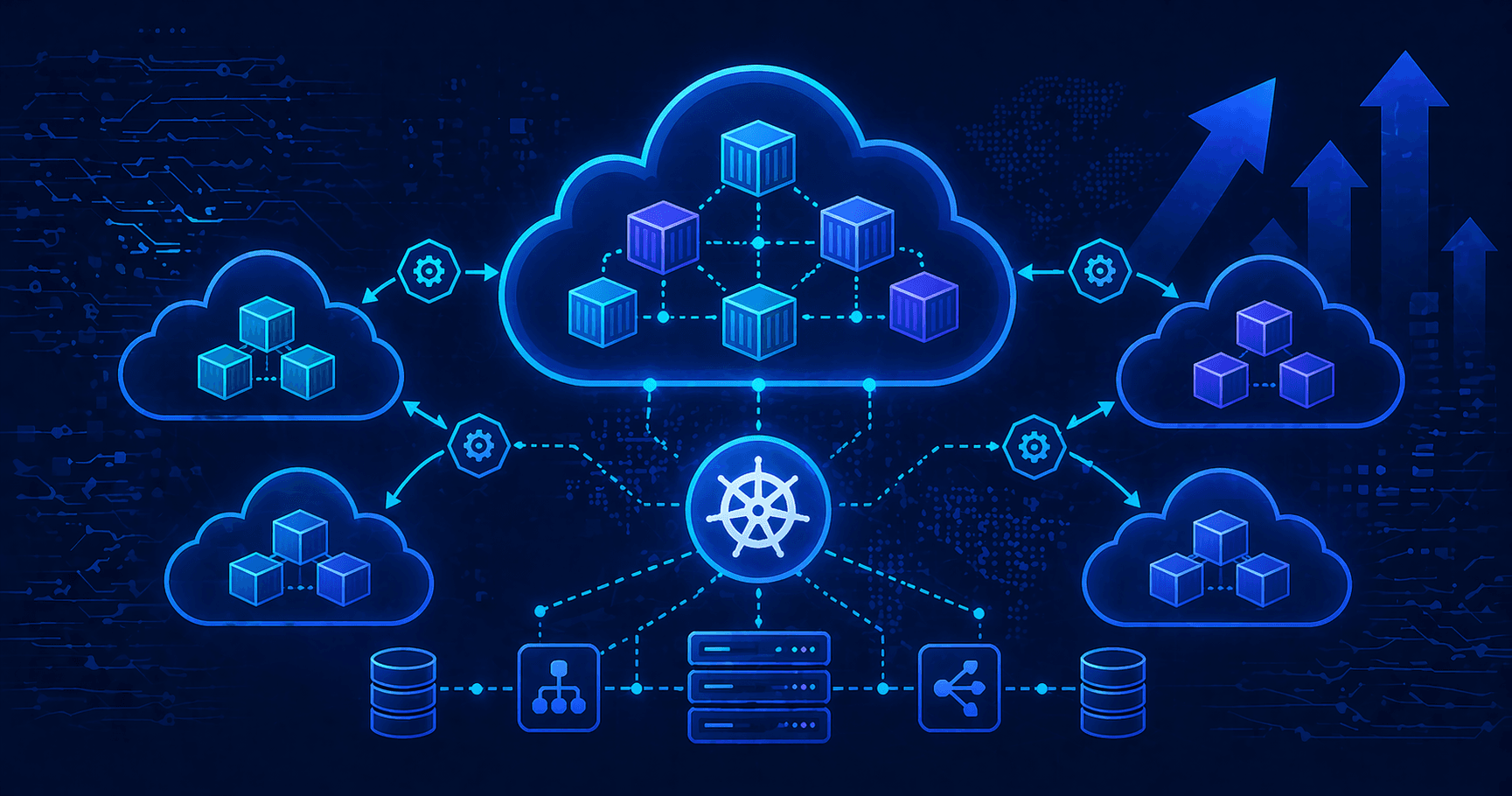
Cloud-native architecture is a set of design principles and practices that fully leverage the capabilities of cloud platforms:
- Containers — Packaging applications with their dependencies into lightweight, portable units using Docker, ensuring consistency from a developer's laptop to production.
- Microservices — Decomposing monolithic applications into small, independent services that can be developed, deployed, and scaled individually.
- CI/CD Pipelines — Automating the build, test, and deployment process so that code changes reach production safely and frequently — often multiple times per day.
- Serverless Computing — Running functions and workloads without managing servers at all, paying only for actual compute consumption.
- Infrastructure as Code — Defining and managing infrastructure through version-controlled configuration files rather than manual provisioning.
- Container Orchestration — Using platforms like Kubernetes to automate deployment, scaling, and management of containerised workloads.
Together, these practices create systems that are resilient, scalable, and designed for change — not against it.
Why Indian Enterprises Should Care Now
The Scale Imperative
India's digital platforms operate at a scale that few countries match. UPI, Aadhaar, IRCTC, and GST Network handle transaction volumes that rival global technology giants. Enterprises building on or integrating with these platforms need architectures that scale elastically — handling 10x traffic spikes during festivals, sales events, or regulatory deadlines without manual intervention.
Monolithic architectures buckle under this kind of demand. Cloud-native architectures are built for it.
Digital India and Government Mandates
The Indian government's push toward digital governance — from e-filing and DigiLocker to the Open Network for Digital Commerce (ONDC) — is creating an ecosystem where businesses must integrate with digital-first government platforms. Cloud-native architectures, with their emphasis on APIs, interoperability, and scalability, are the natural fit.
Regulatory Compliance
India's evolving regulatory landscape — the DPDP Act, RBI's data localisation requirements, SEBI's cybersecurity frameworks — demands architectures that can adapt quickly. Cloud-native systems, with their modular design and infrastructure-as-code approach, make compliance changes a configuration update rather than a months-long re-architecture.
Cost Efficiency in a Price-Sensitive Market
Indian enterprises are acutely cost-conscious — and rightly so. Cloud-native architectures offer fundamental cost advantages: pay-per-use pricing replaces fixed infrastructure costs, auto-scaling eliminates over-provisioning, and serverless computing means you pay only for the compute you actually consume. For mid-sized Indian companies, this can mean the difference between viable and unaffordable digital transformation.
The Real Benefits
Scalability That Matches Demand
Auto-scaling, load balancing, and containerised microservices allow cloud-native applications to handle traffic surges without performance degradation. Scale up during Diwali sales, scale down during quiet periods — automatically.
Faster Time-to-Market
Independent microservices, CI/CD automation, and infrastructure as code mean features ship in days, not months. In competitive Indian markets — fintech, e-commerce, edtech — speed is a decisive advantage.
Operational Resilience
Cloud-native architectures distribute workloads across multiple availability zones and regions. When a component fails — and it will — the system degrades gracefully rather than collapsing entirely. Self-healing mechanisms restart failed containers automatically, often before users notice.
Developer Productivity
Teams working on independent microservices can choose the best technology for each problem, deploy without coordinating with every other team, and debug issues in isolation. This autonomy accelerates development and reduces the coordination overhead that cripples monolithic projects.
The Challenges — And How to Address Them
Cloud-native adoption isn't without obstacles. Acknowledging them honestly is the first step to overcoming them.
Skill Gaps
Cloud-native development requires expertise in Kubernetes, containerisation, distributed systems, observability, and DevOps practices that many Indian engineering teams haven't yet built. The solution isn't to wait — it's to invest in structured training, hire selectively, and partner with experienced firms that can bridge the gap while building internal capability.
Legacy Migration Complexity
Most Indian enterprises aren't building greenfield applications. They're dealing with decades-old monolithic systems — often written in Java, .NET, or COBOL — that power critical business operations. The migration path matters enormously.
Vendor Lock-In
Over-reliance on a single cloud provider's proprietary services can create dependency that limits flexibility and increases costs over time. Mitigate this by using open standards (Kubernetes, Terraform, PostgreSQL), abstracting cloud-specific services behind interfaces, and maintaining a multi-cloud strategy for critical workloads.
Operational Complexity
A microservices architecture with hundreds of services introduces challenges in monitoring, debugging, and managing inter-service communication. Invest early in observability (distributed tracing, centralised logging, metrics dashboards), service mesh technologies, and clear ownership models for each service.
Real-World Migration Patterns
The Strangler Fig Pattern
Named after the strangler fig tree that gradually envelops its host, this pattern involves incrementally replacing parts of a monolithic application with microservices. New features are built as microservices from day one. Existing features are migrated one at a time, routing traffic progressively from the old system to the new.
This approach minimises risk, delivers value incrementally, and avoids the "big bang" rewrite that fails more often than it succeeds. For Indian enterprises running mission-critical monoliths — banking core systems, ERP platforms, insurance policy management — the strangler fig pattern is often the right starting point.
Event-Driven Architecture
Instead of services calling each other directly (creating tight coupling), event-driven architecture uses message brokers like Apache Kafka or Amazon EventBridge to decouple producers from consumers. When something happens — an order is placed, a payment is received, a policy is updated — an event is published, and interested services react independently.
This pattern is particularly powerful for Indian enterprises dealing with high-throughput, asynchronous workflows: payment processing, logistics coordination, real-time inventory management, and regulatory reporting.
API-First Design
Designing APIs before building implementations ensures that services are interoperable, well-documented, and ready for integration with external platforms — whether that's UPI, ONDC, or a partner ecosystem.
Getting Started: A Practical Roadmap
Phase 1: Assess
Evaluate your current application portfolio. Classify each application using the "6 Rs" framework: Retain, Retire, Rehost, Replatform, Refactor, or Rebuild. Not everything needs to be cloud-native — focus on the applications that will benefit most.
Phase 2: Pilot
Select one or two non-critical applications for cloud-native implementation. Build them using containers, microservices, and CI/CD pipelines. Establish your DevOps practices, toolchain, and team workflows. Learn from the experience before scaling.
Phase 3: Migrate Strategically
Apply the strangler fig pattern to your high-value monoliths. Migrate incrementally, validate at each step, and maintain rollback capabilities. Invest in automated testing and observability to ensure confidence throughout the migration.
Phase 4: Scale and Optimise
Expand cloud-native adoption across your application portfolio. Implement FinOps practices to optimise cloud spending. Build platform engineering teams to provide standardised, self-service infrastructure for development teams across the organisation.
How Sdevratech Helps
Cloud-native transformation is not a technology project — it's an organisational shift that requires architectural expertise, operational discipline, and a pragmatic approach to change management.
At Sdevratech, we bring:
- Architecture-first consulting — We design cloud-native architectures tailored to your business context, not generic reference implementations copied from documentation.
- Migration execution — From strangler fig migrations to full greenfield builds, we deliver hands-on engineering alongside strategic guidance.
- DevOps and platform engineering — We establish the CI/CD pipelines, observability frameworks, and infrastructure-as-code foundations that make cloud-native operations sustainable.
- Training and enablement — We build your team's capabilities alongside delivering the solution, ensuring you're not dependent on us long-term.
Our approach is shaped by our leadership's Defence sector background — where systems must be reliable, secure, and built to handle worst-case scenarios. We apply the same rigour to cloud-native architecture.
The Bottom Line
Indian enterprises face a unique combination of massive scale requirements, rapid regulatory evolution, cost pressures, and a fiercely competitive digital landscape. Cloud-native architecture isn't a luxury — it's the foundation that enables organisations to meet these challenges while remaining agile enough to seize new opportunities.
The enterprises that adopt cloud-native practices today will outpace those that delay. The technology is mature, the patterns are proven, and the ecosystem is ready.
Ready to begin your cloud-native journey? Connect with Sdevratech Technologies — Smart. Secure. Scalable.