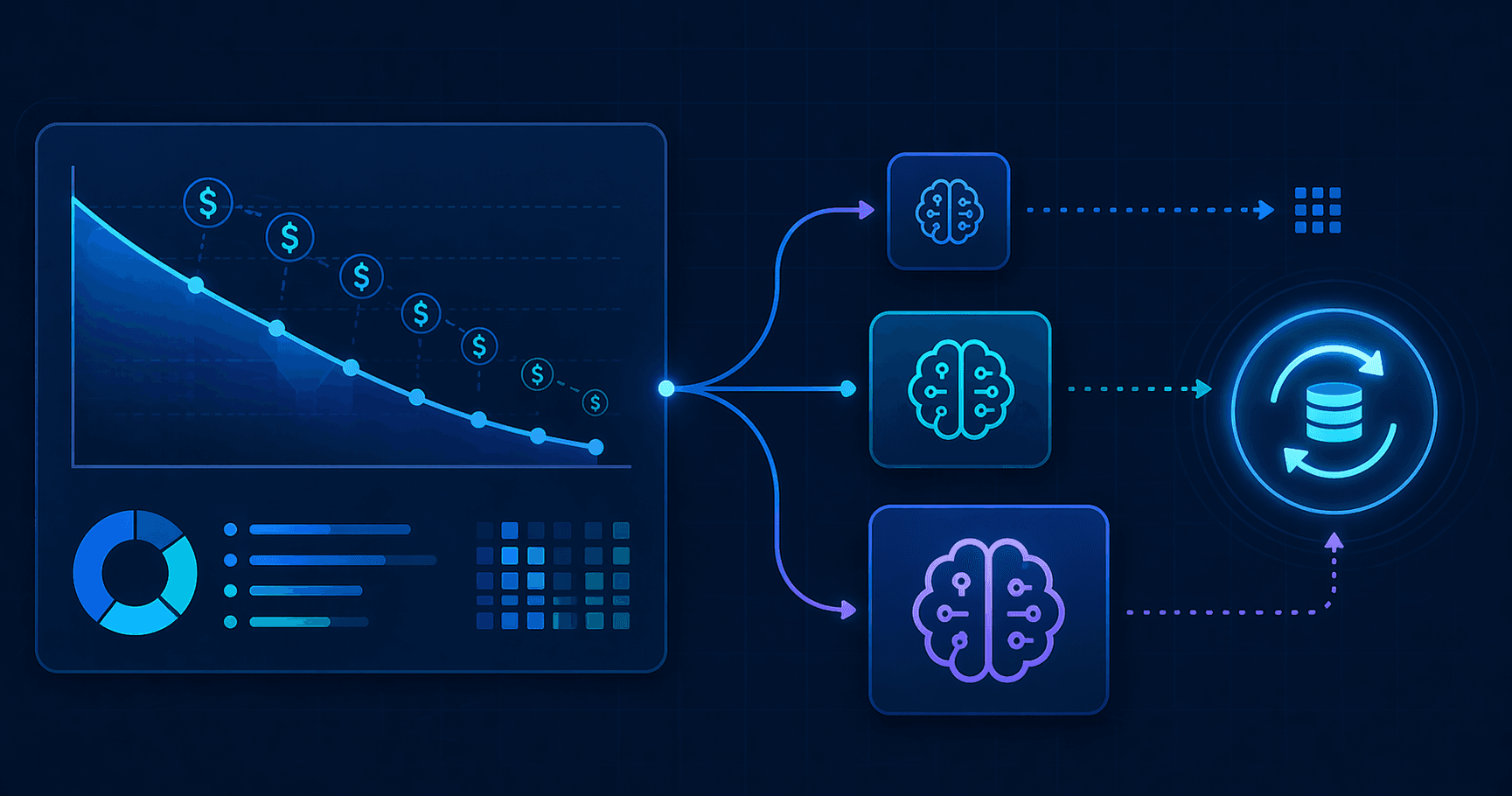
LLM Cost Optimization: Caching, Routing, and When to Fine-Tune
Every team shipping agentic AI features eventually runs into the same wall: the demo is magical, but the production bill is brutal. A single agent loop can fan out into dozens of LLM calls, and costs scale linearly with users. The good news — most of that spend is avoidable. Before you cap usage or downgrade models, work through these three levers in order.
1. Prompt Caching: The Easiest Win
Modern LLM APIs support prompt caching, where a static prefix of your prompt (system instructions, tool definitions, retrieved documents) is cached on the provider side and billed at a fraction of the input rate — typically 10% of normal input cost on cache hits.
For agentic workloads, this is transformative. A coding agent that sends the same 20,000-token system prompt on every turn can see 70–90% input cost reductions with a one-line code change. The rules are simple:
- Put stable content first, variable content last.
- Keep cache prefixes identical byte-for-byte across requests.
- Watch TTLs — prompt caches typically expire after a few minutes of inactivity.
If you're not using prompt caching yet, start here before touching anything else.
2. Model Routing: Right-Sizing Every Call
Not every LLM call needs your biggest model. A well-designed agent uses a cascade: cheap, fast models handle classification, extraction, and routine steps, while the frontier model is reserved for reasoning, planning, and code generation.
In practice this means:
- Haiku / small models for intent classification, tool selection, and summarization.
- Sonnet / mid-tier models for most tool-use and retrieval-augmented steps.
- Opus / frontier models for planning, complex reasoning, and long-horizon tasks.
A simple router — even a rule-based one on prompt type or estimated difficulty — often cuts costs by 40–60% with negligible quality loss. Measure quality per tier with evals before you ship; don't guess.
3. When to Fine-Tune (and When Not To)
Fine-tuning is the lever teams reach for first and should reach for last. It adds training cost, inference cost (fine-tuned endpoints are often pricier than base models), operational complexity, and a moving target every time the base model is updated.
Fine-tune when:
- You have a narrow, high-volume task where prompt engineering has plateaued.
- You need to reduce prompt length dramatically (e.g., replacing a 5K-token instruction block with baked-in behavior).
- You have thousands of high-quality examples and a clear eval that distinguishes "good" from "great."
Skip fine-tuning when RAG, better prompts, or a smaller routed model would solve the problem. In 2026, few-shot prompting with caching is astonishingly strong — most "we need to fine-tune" instincts are actually "we need better retrieval" or "we need evals."
Putting It Together
A realistic cost-optimized architecture looks like this: a router classifies incoming requests, cached system prompts carry the heavy context, small models handle 70% of calls, a frontier model handles the hard 30%, and fine-tuning is reserved for one or two narrow, proven bottlenecks. Teams that apply this pattern routinely see 5–10× cost reductions versus their first production deployment.
At Sdevratech, we help teams instrument their LLM workloads, build routing and caching layers, and run the evals that make these tradeoffs visible. Agentic AI doesn't have to be expensive — it has to be engineered.