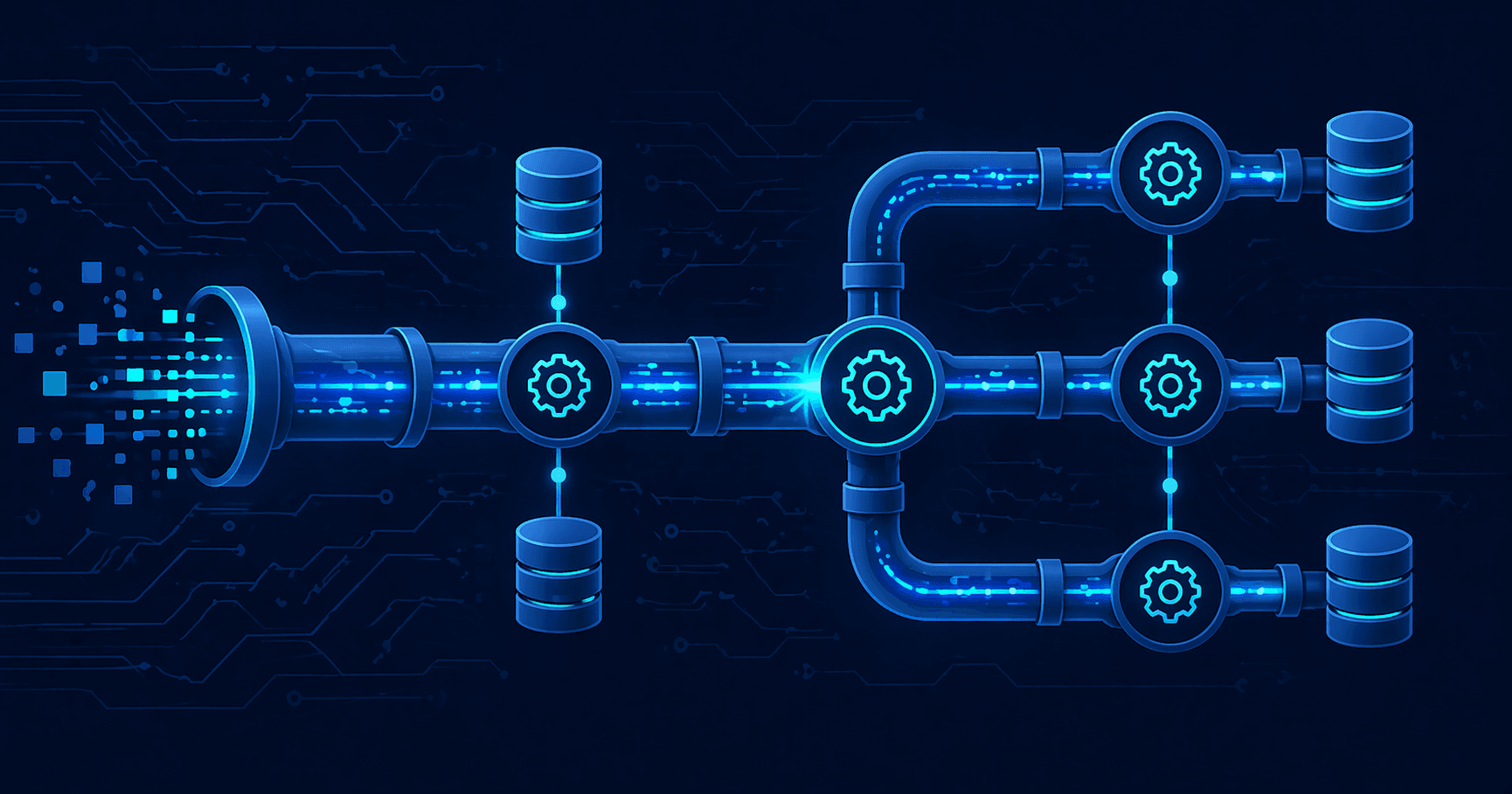
Building Scalable Data Pipelines: Lessons from the Field
Data is only as valuable as your ability to move, transform, and deliver it reliably. Yet many organizations struggle with fragile pipelines that break at scale, produce inconsistent results, or become impossible to maintain. Here are practical lessons from real-world implementations.
1. Design for Failure from Day One
Every component in a data pipeline will eventually fail — a source API times out, a schema changes without notice, a downstream system goes offline. The question isn't if, but when.
Build resilience into your architecture:
- Implement retries with exponential backoff for transient failures
- Use dead-letter queues to capture and reprocess failed records without blocking the entire pipeline
- Design idempotent operations so reprocessing doesn't create duplicates
- Add circuit breakers to prevent cascading failures across dependent systems
2. Separate Ingestion, Transformation, and Serving
The most maintainable pipelines follow a clear layered architecture:
- Bronze (Raw): Ingest data as-is from sources with minimal transformation. Preserve the original format for auditability.
- Silver (Cleaned): Apply schema validation, deduplication, type casting, and business rules. This is your single source of truth.
- Gold (Aggregated): Build purpose-specific datasets optimized for analytics, dashboards, or ML model training.
This separation makes debugging straightforward, allows teams to work independently on different layers, and prevents a change in one area from breaking everything downstream.
3. Choose the Right Tool for the Right Job
The data engineering ecosystem is vast. Resist the temptation to use one tool for everything:
- Batch processing: Apache Spark, AWS Glue, or dbt for scheduled, large-volume transformations
- Stream processing: Apache Kafka, AWS Kinesis, or Apache Flink for real-time data flows
- Orchestration: Apache Airflow, Dagster, or AWS Step Functions to coordinate complex workflows
- Storage: Choose between data lakes (S3, ADLS), data warehouses (Redshift, BigQuery, Snowflake), or lakehouses (Delta Lake, Apache Iceberg) based on your query patterns
The best architecture often combines several of these, each handling what it does best.
4. Invest in Data Quality Early
Bad data in means bad decisions out. Data quality isn't a nice-to-have — it's a prerequisite for trust in your analytics and AI.
Implement quality checks at every stage:
- Schema validation at ingestion to catch structural changes immediately
- Freshness monitoring to detect when sources stop sending data
- Volume anomaly detection to flag unexpected spikes or drops in record counts
- Business rule assertions to verify that transformed data meets domain expectations
Tools like Great Expectations, dbt tests, or Monte Carlo can automate these checks and alert your team before bad data reaches consumers.
5. Make Pipelines Observable
You can't fix what you can't see. Production pipelines need comprehensive observability:
- Logging: Structured logs at each pipeline stage with correlation IDs for end-to-end tracing
- Metrics: Track processing time, record counts, error rates, and data freshness per pipeline
- Alerting: Set meaningful thresholds — not just "pipeline failed" but "pipeline took 3x longer than usual" or "output row count dropped by 40%"
- Lineage: Track where data comes from, how it's transformed, and where it goes. When something breaks, lineage tells you the blast radius.
6. Version Everything
Treat your data pipelines like software:
- Version control all transformation logic, schemas, and configurations in Git
- Use migrations for schema changes rather than manual DDL
- Tag releases so you can roll back to a known-good state
- Test transformations with sample data before deploying to production
This discipline pays dividends when debugging production issues at 2 AM.
7. Plan for Scale Before You Need It
Pipelines that work with 10,000 records often collapse at 10 million. Design with growth in mind:
- Partition data by date, region, or other natural keys to enable parallel processing
- Use incremental processing instead of full reloads wherever possible
- Leverage auto-scaling compute resources to handle variable workloads cost-effectively
- Monitor costs as data volumes grow — cloud bills can surprise you
The Bottom Line
Building scalable data pipelines isn't about choosing the trendiest technology — it's about disciplined engineering, thoughtful architecture, and relentless attention to reliability. The organizations that get data engineering right build a foundation that powers better decisions, faster analytics, and more effective AI.
At Sdevratech, we design and build data pipelines that don't just work in demos — they perform reliably at scale, day after day, in production. If your data infrastructure needs to level up, let's talk.